

Picosecond Ultrasonics (PULSE Technology) has been widely adopted as the tool-of-record for metal film thickness metrology in semiconductor fabs around the world. It provides unique advantages, such as being a rapid, non-contact, non-destructive technology, and has capabilities for simultaneous multiple layer measurement. In this paper, we describe the unique advantages of Picosecond Ultrasonics for advanced radio frequency (RF) applications. RF filter process control requires stringent metrology due to tight process tolerances. The first principles-based PULSE technology does not require external calibration standards and provides robust measurement capability for multi-layer thickness measurements. For advanced RF applications, the capability of PULSE technology to measure both velocity and thickness simultaneously for transparent and semi-transparent films offers a lot of potential for not only monitoring processes but offers insight into the device performance. The PULSE technique can also simultaneously measure full stack for multilayer metal stack measurements with excellent repeatability and long-term stability which makes process control more efficient and reliable. Fast throughput makes it possible for a high sampling rate for RF applications which is the key for device level process control and yield improvement.
The global RF semiconductor market size is growing rapidly at a CAGR of 8.5% in the next five years from 17.4 billion in 2020 to 26.2 billion USD in 2025. The rollout of 5G technology and its enabled Internet of Things (IoT) are the main driving force for this growth. Each 5G device requires up to 100 filters to make sure each band is isolated to avoid interference that will drain battery life, reduce data speeds, and cause dropped calls. RF filters are becoming more and more critical for all signal process applications. 5G devices require Bulk Acoustic Wave (BAW) filters which can work better at higher frequencies. With more and more filters to fit into a device, the size of filters is also shrinking dramatically in three dimensions. These advances in filter technology place stringent demands on manufacturing which in turn requires accurate and precise metrology techniques. Both thickness and acoustic properties of the piezoelectric layer determine the frequency response of filters. Thickness accuracy and uniformity requirements for the films are beyond what process tools can offer at deposition and there are several options available to achieve such tight controls post-deposition. Metrology techniques employed for characterizing these properties must meet the sensitivity, accuracy, and stringent repeatability requirements. The thickness of the full stack and especially the thickness and sound velocity of the piezoelectric layer are key to realizing the extremely tight process control of frequency accuracy (3σ) of 0.1% or better. A high sampling rate on a hundred-micron level device is needed to make sure all devices across the wafer can meet the requirements which require fast throughput with a small measurement probe.
Fan-out wafer level packaging (FOWLP) is a popular new packaging technology that allows the user to increase I/O in a smaller IC size than fan-in wafer level packaging. Market drivers such as 5G, IoT, mobile and AI will all use this technology. According to Yole Développement’s analysis, the fan-out packaging market size will increase to $3 billion in 2022 from $2.44 hundred million in 2014, validating the market requirement for fan out packaging. While FOWLP has been used for many years, there is still a relentless drive to reduce the cost, and fan-out panel level packaging (FOPLP) has been proposed as one possible solution. FOPLP allows users to put more chips on a substrate, meaning more product output and a higher substrate utilization percentage. According to Yole’s analysis, the FOPLP market size will increase to $2.79 hundred million with 79% CAGR, showing that more people are adopting FOPLP.
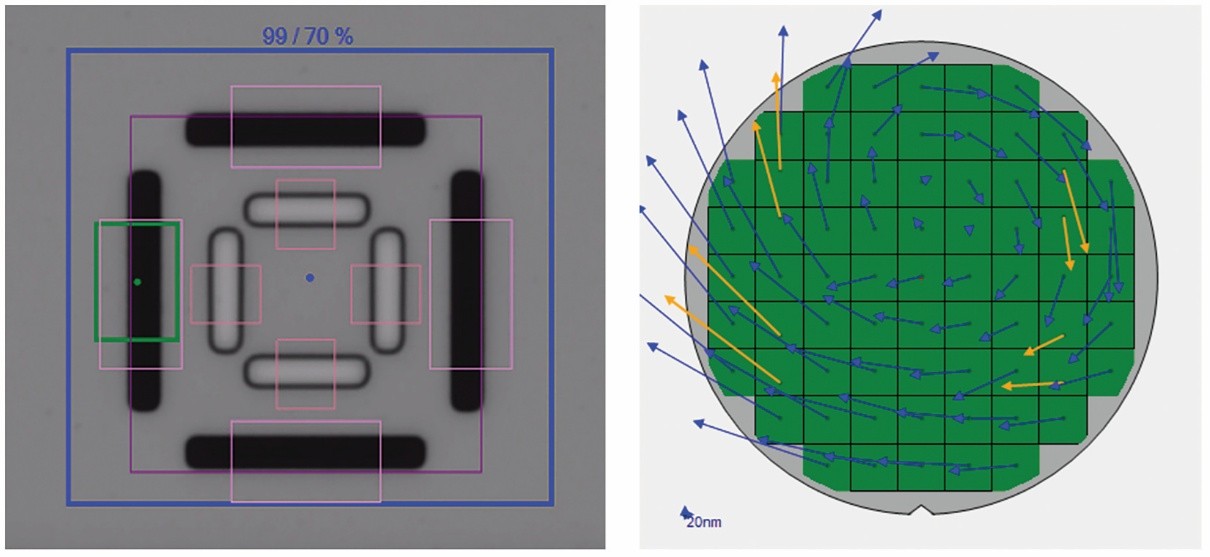
FOPLP has many advantages and low cost potential, but it faces significant process challenges, such as die placement error and substrate warpage control. One of the key challenges is the trade-off between overlay, yield, and throughput during the lithography processing steps. A user exposes multiple dies per exposure shot to increase throughput, but this can result in lower overlay yield because of “pick and place” die placement error. To overcome the low yield issue, each die needs to be aligned, but this impacts throughput, so a compromise is required. To find the balance point between throughput and overlay is one of the biggest challenges for FOPLP.
In this paper we address the tradeoff between throughputs and overlay yield, we demonstrate an integrated feedforward adaptive shot solution. This feedforward approach uses a third party metrology system to measure reconstituted panel die location data and sends the data to the stepper via a network. With feedforward algorithm technology, the stepper uses smart adaptive shot technology to generate an optimized variable shot size layout. This layout ensures the overlay yield is within specification with the minimum number of exposure steps. With feedforward adaptive shot technology, the user can maximize the throughput of the stepper and ensure the overlay yield at the same time.
Key words: advanced packaging, die placement error, FOWLP, FOPLP, overlay, yield, feedforward.
Amorphous carbon (a-C) based hard masks provide superior etch selectivity, chemical inertness, are mechanically strong, and have been used for etching deep, high aspect ratio features that conventional photoresists cannot withstand. Picosecond Ultrasonic Technology (PULSE Technology) has been widely used in thin metal film metrology because of its unique advantages, such as being a rapid, non-contact, non-destructive technology and its capabilities for simultaneous multiple layer measurement [1]. Simultaneous measurement of velocity and thickness for transparent and semi-transparent films offers a lot of potential for not only monitoring the process but offers insight into the device performance. In this paper, we show successful applications of Picosecond Ultrasonics in 3D NAND. This includes measurement of various thin metal films and simultaneous measurement of sound velocity and thickness for amorphous carbon films which has been widely used as hard mask materials.
Picosecond Ultrasonics (PULSE Technology) has been widely used in thin metal film metrology because of its unique advantages, such as being a rapid, non-contact, non-destructive technology and its capabilities for simultaneous multiple layer measurement. Measuring velocity and thickness simultaneously for transparent and semi-transparent films offers a lot of potential for not only monitoring process but offers insight into the device performance. In this paper, we show Picosecond Ultrasonics provides a complete metrology solution in advanced radio frequency (RF) applications. This includes measurement of various thin metal films for wide thickness ranges with extremely excellent repeatability which could meet stringent process control requirements, simultaneous multilayer measurement capability, and simultaneous measurement of sound velocity and thickness for piezoelectric films which play a key role in the performance of RF devices.