

All great voyages must come to an end. Such is the case with our series on the challenges facing the manufacturing of advanced IC substrates (AICS), the glue holding the heterogeneous integration ship together.
In our first blog, we examined how cumulative overlay drift from individual redistribution layers could significantly increase overall trace length, resulting in higher interconnect resistance, parasitic effects and poor performance for high-speed and high-frequency applications. To address this, layer to layer overlay performance data needs to be monitored at each layer. If the total overlay error exceeds specifications at any process step, and at any location on the panel, corrective action must be taken to mitigate the drift in total overlay.
For this second installment, we explored the issue of AICS package yield and its importance in fostering a cost-effective, production-worthy process. Unlike most fan-out panel-level packaging (FOPLP) applications, AICS has relatively few packages per panel. This enormous disparity impacts yield calculations dramatically. In the AICS production process, the main challenge is the real-time tracking of yield for every panel, at every layer, throughout the fab. The solution: using advanced automatic defect classification (ADC) and yield analytics to quickly address errors.
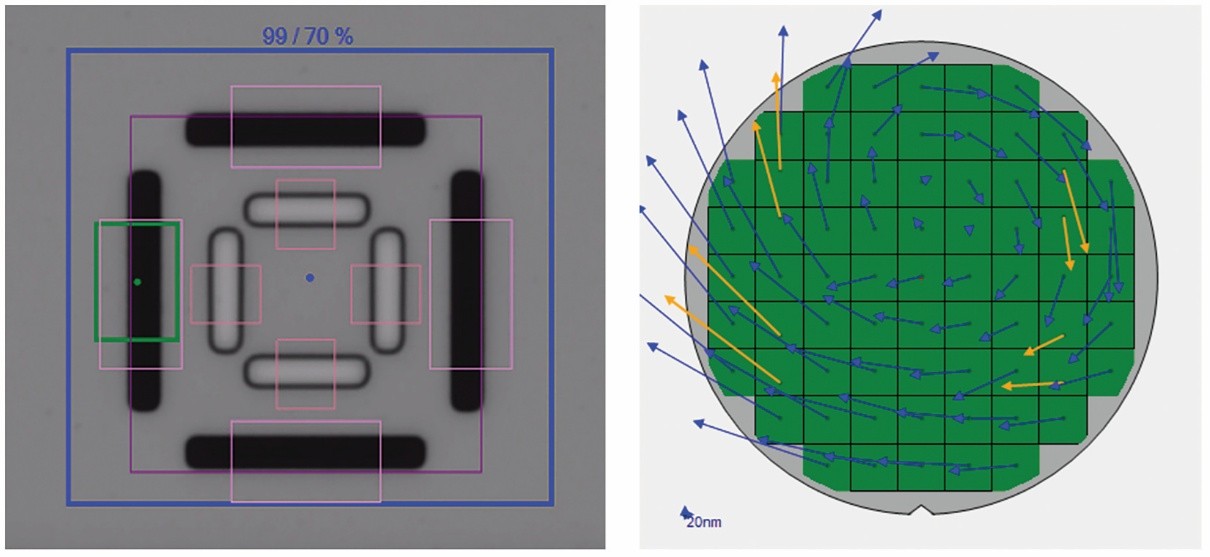
In this final article of the series, we explore how overlay correction solutions compensate for panel distortion effects induced by copper clad laminate (CCL) processing, which impacts yield and final package performance.
No matter how you get your news, it seems like everyone is talking about AI – and it’s either going to usher in a new era of productivity or lead to the end of humankind itself. Regardless, the AI era is here, and it’s just beginning to have an impact on our lives, our jobs and our future.
To meet the rigorous demands of AI – along with high-performance compute, 5G and electric vehicles – the semiconductor industry is seeking out new innovations to increase speed, bandwidth and functional density, lower energy usage, cost and latency. At the top of the list: heterogeneous integration. And to make heterogeneous integration a reality, back-end packaging houses use advanced integrated circuit substrates (AICS).
In a previous blog, we focused on one of the major challenges of manufacturing AICS – total overlay drift. For this second installment in our three-part series on packaging solutions, we explore the issue of AICS package yield and its importance in fostering a cost-effective, production-worthy process.
For years, many in the semiconductor industry have focused on the march toward advanced nodes. As these nodes have decreased in size, the size of input/output (I/O) bumps on the chip has grown smaller. As these bumps shrink, their ability to mate directly to printed circuit boards (PCB) diminishes, which, in turn, leads to the need for an intermediary substrate. Enter the advanced IC substrate (AICS).
The use of AICS also enables advances in panel-level packaging and the rise of chiplet-based architectures, where the final product is an assembled composite of multiple die supporting the core central processing unit (CPU) or graphics processing unit (GPU). These additional die may be memory elements, analog devices or other functions. All these die can be co-packaged on the AICS, which allows multiple die with small I/O contacts to be assembled and redistributes them to larger contact bumps compatible with a PCB.
With panel-level packaging, manufacturers can deliver packages offering faster data transfer, greater heat dissipation, less power consumption and increased functionality. And unlike the front-end where higher resolution involves ever smaller patterns, package sizes are only increasing in size.
For high-performance computing, artificial intelligence, and data centers, the path ahead is certain, but with it comes a change in substrate format and processing requirements. Instead of relying on the quest for the next technology node to bring about future device performance gains, manufacturers are charting a future based increasingly on heterogeneous integration.
But while heterogeneous integration promises more functionality, faster data transfer, and lower power consumption, these chiplet combinations, with different functionalities and nodes, will require increasingly larger packages, with sizes at 75mm x 75mm, 150mm x 150mm, or even larger.
To further complicate matters, these packages will also feature elevated numbers of redistribution layers, in some cases as high as 24 layers. And with each of those layers, the threat of a single killer defect, which would effectively ruin an entire package, increases. As such, the ability to maintain high yields becomes increasingly difficult.
The More than Moore era is upon us, as manufacturers increasingly turn to back-end advances to meet the next-generation device performance gains of today and tomorrow. In the advanced packaging space, heterogeneous integration is one tool helping accomplish these gains by combining multiple silicon nodes and designs inside one package.
But as with any technology, heterogeneous integration, and the fan-out panel-level packaging that often enables it, comes with its own set of unique challenges. For starters, package sizes are expected to grow significantly due to the number of components making up each integrated package. The problem: these significantly bigger packages require multiple exposure shots to complete the lithography steps for the package. Adding to this, multiple redistribution layers (RDL) may cause stress to both the surface and inside of the substrate, resulting in warpage. And then there is the matter of tightening resolution requirements and more stringent overlay needs.
Heterogeneous integration enables multiple chips from varying Silicon processes to deliver superior performance. In large panel packages, present day limits on exposure field size forces manufacturers to ‘stitch’ together multiple reticles, which slows throughput and increases costs. Onto Innovation’s new JetStep® X500 system dramatically increases the exposure field up to 250 x 250 mm, slashing the number of exposures needed and cutting costs in FOPLP applications.
HIGH-PERFORMANCE compute, 5G, smartphones, data centers, automotive, artificial intelligence (AI) and the Internet of Things (IoT) – all rely on heterogeneous integration to achieve next-level performance gains. By combining multiple silicon nodes and designs inside one package, ranging in size from 75mm x 75mm to 150mm x 150mm, heterogeneous integration is one factor bringing us closer toward an era in which technology is beneficially embed into nearly all aspects of our lives whether it’s in the smart factories where we work, the self-driving cars that navigate the cities in which we live, the mobile devices that connect us to each other and the wearable devices that help us live healthier lives.
Regardless of the speed to which we are approaching this promising new era, this transition comes with increasing challenges, ones that are constrained by increasingly stringent requirements. The next-generation of heterogeneous integration technologies, and the fan-out, panel-level packaging that often accompanies it, will demand even tighter overlay requirements to accommodate larger package sizes with fine-pitch chip interconnects on large-format, 510mm x 515mm flexible panels.